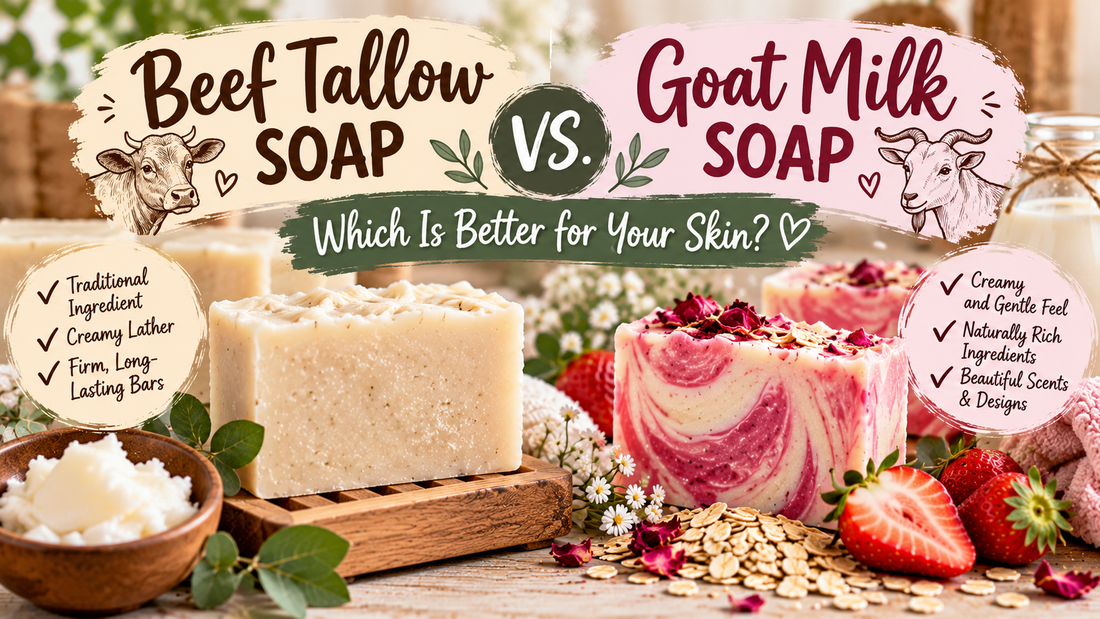
Beef Tallow Soap vs. Goat Milk Soap: Which Is Better for Your Skin? 🧼🐐
Two traditional ingredients. Two unique soap-making approaches. One surprisingly interesting skincare debate!
If you've spent any time exploring handmade soaps lately, you've probably noticed two ingredients getting plenty of attention: beef tallow and goat milk.
One comes from a centuries-old tradition of making soap with rendered animal fats. The other brings creamy dairy ingredients into the world of artisan soap making.
Both have loyal fans, both have fascinating histories, and both can produce beautiful handmade soap bars.
But here's the question everyone wants answered:
Is beef tallow soap or goat milk soap actually better for your skin?
The answer isn't quite as simple as you might think!
Today, we're comparing these two popular soap varieties, exploring their differences, and helping you decide which one might deserve a place in your shower.
And don't worry. There won't be a chemistry exam at the end. 😉
🐄 What Is Beef Tallow Soap?
Let's start with an ingredient that has been around for generations.
Beef tallow is rendered beef fat, traditionally used to make soap, candles, and other household products.
When properly combined with an alkali during soap making, tallow undergoes a chemical reaction called saponification, creating soap.
Beef tallow contains a combination of fatty acids, including palmitic, stearic, and oleic acids. These contribute to characteristics such as bar hardness and creamy lather.
Why Do People Love Beef Tallow Soap?
Beef tallow soap is popular for several reasons:
-
Firm, traditional bars: Tallow can contribute to a hard soap bar that holds its shape well.
-
Creamy lather: Tallow-based formulas can produce a dense, creamy foam.
-
Classic soap-making tradition: It appeals to people who appreciate time-honored ingredients.
-
Simple formulations: Tallow can be used in uncomplicated recipes, including fragrance-free options.
Of course, not every tallow soap is formulated the same way. The other ingredients in the recipe influence how the finished bar performs.
Meet Our Grass-Fed Beef Tallow Soap
At Tina's Tiny Things, our Grass-Fed Beef Tallow Unscented Soap Bar offers a traditional soap experience without added fragrance.
It's an appealing option for people who prefer unscented bath products and appreciate classic soap-making ingredients.
Fun Fact: The word tallow might sound unusual today, but animal-fat-based soaps were everyday household essentials long before modern bottled body wash became popular.
🐐 What Is Goat Milk Soap?
Now let's meet the other contender.
Goat milk soap is made using goat milk as part of the liquid in a soap recipe.
Goat milk naturally contains fats, proteins, sugars, and other components that make it an interesting ingredient for soap makers.
When incorporated into a properly formulated soap, goat milk can contribute to a creamy texture and rich lather.
Why Do People Love Goat Milk Soap?
Goat milk soap has earned its popularity for several reasons:
-
Creamy washing experience: Many goat milk formulations create a smooth, satisfying lather.
-
Versatile fragrance options: Goat milk soaps can be unscented or made with a wide range of fragrances.
-
Traditional inspiration: Milk-based bathing and beauty preparations have a long history.
-
Artisan creativity: Goat milk can be incorporated into colorful, decorative, and beautifully scented bars.
One important point: Goat milk soap isn't automatically more moisturizing or gentler than every other soap.
The full formula—including the oils, fragrance, and other additives—determines how the soap feels and performs.
Meet Our Strawberries & Cream Goat Milk Soap
If you love a little sweetness in your bath routine, our Strawberries & Cream Goat Milk Soap Bar offers a playful take on this traditional ingredient.
Its strawberries-and-cream inspiration brings a fun, dessert-like personality to an everyday cleansing bar.
Just remember: It might look delicious, but it's definitely not edible! 🍓
⚖️ Beef Tallow Soap vs. Goat Milk Soap: Side-by-Side Comparison

Beef tallow soap vs. goat milk soap: Two traditional soap-making ingredients with different characteristics. Discover which handmade soap best matches your preferences.
So how do these two popular soap types compare?
| Feature | Beef Tallow Soap | Goat Milk Soap |
|---|---|---|
| Main featured ingredient | Rendered beef fat | Goat milk |
| Ingredient's role | A primary soap-making fat | A milk ingredient added to the recipe |
| Typical lather | Can be dense and creamy | Often creamy; varies by formula |
| Bar hardness | Tallow can contribute firmness | Depends mainly on the soap's oils and fats |
| Fragrance options | Unscented or scented | Unscented or scented |
| Traditional appeal | Classic animal-fat soap making | Traditional milk-based skincare |
| Best fit | Fans of classic, simple soap formulations | Fans of creamy, milk-based artisan soaps |
The biggest difference?
Beef tallow is a fat used to create the soap itself, while goat milk is generally incorporated as an additional ingredient alongside the fats and oils used for saponification.
And here's an interesting twist: A soap maker could technically create a bar containing both beef tallow and goat milk!
They're not mutually exclusive ingredients.
💧 Which Soap Is Better for Dry Skin?
This is probably one of the most common questions people ask when comparing soap ingredients.
And the answer might surprise you.
Neither beef tallow soap nor goat milk soap is automatically better for dry skin.
Although both can produce a pleasant, creamy washing experience, traditional soap is generally alkaline.
For some people, particularly those with very dry or sensitive skin, an alkaline cleanser may feel drying or irritating.
The full formulation matters much more than a single featured ingredient.
For example, two tallow soaps can perform differently depending on the oils, superfat level, additives, and production process.
The same is true for goat milk soaps.
If you experience persistent dryness, eczema, or easily irritated skin, a mild, fragrance-free, pH-balanced cleanser may be a better choice.
Our takeaway: Focus on how your skin responds to the finished product rather than assuming one ingredient guarantees better results.
🌸 Which Soap Is Better for Sensitive Skin?
Let's clear up a common misconception.
Natural ingredients aren't automatically non-irritating.
Even beautifully handcrafted soap can contain ingredients that don't agree with everyone's skin.
Fragrance is one factor worth considering.
Some people love fruity, floral, or botanical fragrances, while others prefer products without added scent.
That's where comparing individual soap bars becomes more useful than comparing broad categories.
For example, Tina's Tiny Things offers an unscented beef tallow soap and a strawberries-and-cream goat milk soap.
Someone avoiding added fragrance might prefer the unscented option, regardless of whether it's made with tallow or goat milk.
However, fragrance-free doesn't guarantee that a product will be suitable for every skin type.
Helpful Tip: When trying a new cleanser, pay attention to dryness, itching, redness, or discomfort. Stop using a product if irritation develops.
🫧 Which Soap Makes Better Bubbles?
Let's be honest.
Half the fun of a great shower is the lather!
But which soap wins the bubble competition?
Here's the twist.
Neither beef tallow nor goat milk automatically guarantees bigger bubbles.
The oils and fats used in a soap recipe influence the amount and character of the lather.
For example, coconut oil is often used in soap-making formulations to help create bubbly foam.
Tallow can contribute a creamier, denser lather.
Goat milk soaps can also feel creamy, but their bubble production depends on the fats and oils in the formula.
Fun Fact: More bubbles don't necessarily mean a soap cleans better.
So if your soap creates a rich, creamy lather instead of mountains of fluffy bubbles, that doesn't mean it isn't doing its job.
🌿 What About Natural Ingredients?
Both beef tallow and goat milk are ingredients derived from animals, but they serve different purposes in soap making.
Tallow provides fatty acids that become part of the soap during saponification.
Goat milk is incorporated into the recipe and contributes milk components, while the oils and fats supply most of the soap-forming material.
It's also worth remembering that the word natural doesn't automatically tell you how gentle, effective, or suitable a product will be.
Ingredient quality, formulation, and appropriate manufacturing practices all matter.
At Tina's Tiny Things, we appreciate the variety that traditional soap-making ingredients bring to our handmade artisan soap collection.
From the classic simplicity of tallow to the creamy appeal of goat milk, each type has its own personality.

Discover how traditional ingredients such as beef tallow and goat milk contribute to different handmade soap formulations
🛁 Can You Use Both Beef Tallow and Goat Milk Soap?
Absolutely!
There's no rule saying your bathroom must choose sides.
Some people enjoy keeping different soap bars available depending on their preferences.
Maybe you prefer an unscented bar for everyday use.
Maybe you enjoy a sweetly scented goat milk bar when you're in the mood for something different.
Or perhaps you simply enjoy exploring the variety of textures, colors, and fragrances found in artisan soaps.
That's part of the fun of handmade soap.
You don't have to declare a winner to enjoy both.
🧼 What Makes Handmade Soap So Interesting?
One of our favorite things about handmade soap is the creativity behind it.
A soap maker can begin with a traditional ingredient like tallow or goat milk and develop entirely different products by adjusting the recipe.
One bar might be simple and unscented.
Another might have colorful swirls, a playful fragrance, and a beautifully textured top.
At Tina's Tiny Things, we love celebrating those differences.
Our handmade soap selections include traditional favorites and creative artisan varieties, making it fun to discover different styles of soap.
Whether you appreciate the simplicity of an unscented tallow bar or the sweet personality of strawberries-and-cream goat milk soap, there's something special about a product that combines everyday usefulness with thoughtful craftsmanship.
Frequently Asked Questions: Beef Tallow vs. Goat Milk Soap
Is beef tallow soap better than goat milk soap?
Neither is universally better. Beef tallow contributes to the soap's fatty acid composition, while goat milk is added to a soap formula for its milk components. The overall recipe determines the finished product's qualities.
Is beef tallow soap good for dry skin?
Some people enjoy the creamy lather of tallow-based soap, but traditional soap can still be drying. People with dry or sensitive skin may benefit from a mild, fragrance-free cleanser formulated specifically for their needs.
Does goat milk soap contain lactic acid?
Goat milk naturally contains lactic acid, but the amount and behavior of lactic acid in finished soap differ from those in a dedicated exfoliating skincare treatment. Goat milk soap shouldn't be assumed to provide clinically meaningful chemical exfoliation.
Is beef tallow soap vegan?
No. Beef tallow is an animal-derived ingredient, so beef tallow soap is not vegan.
Is goat milk soap vegan?
No. Goat milk is an animal-derived dairy ingredient, so goat milk soap is not vegan.
Which soap is better for sensitive skin?
Neither category guarantees suitability. A fragrance-free, mild formulation may be preferable for sensitive skin, and some people may do better with a non-soap cleanser.
Can goat milk soap contain beef tallow?
Yes. Goat milk and beef tallow can be used in the same soap recipe. One supplies milk components while the other supplies soap-making fat.
How should I store handmade soap?
Keep your soap on a well-draining soap dish, away from standing water. Allowing the bar to dry between uses can help extend its lifespan.
💕 The Final Verdict: Which Soap Wins?
After comparing ingredients, lather, fragrance, and traditional soap-making methods, here's our conclusion.
It's a tie!
Not because the two soaps are identical.
Far from it.
Beef tallow and goat milk serve different roles in soap making, and each brings something interesting to the process.
Beef tallow appeals to people who enjoy classic, traditional soap formulations and creamy lather.
Goat milk appeals to people who enjoy milk-based artisan soap and the many creative formulations it can inspire.
The best choice depends on your preferences, the complete ingredient list, and how your skin responds.
If you're curious about the difference, explore the Grass-Fed Beef Tallow Unscented Soap Bar and the Strawberries & Cream Goat Milk Soap Bar from Tina's Tiny Things.
Sometimes the most enjoyable way to discover your favorite is simply to experience the differences yourself.
Until next time…
Stay bubbly, stay curious, and enjoy the little things! 🧼💕
— The Tina's Tiny Things Family
Because every tiny thing matters.


