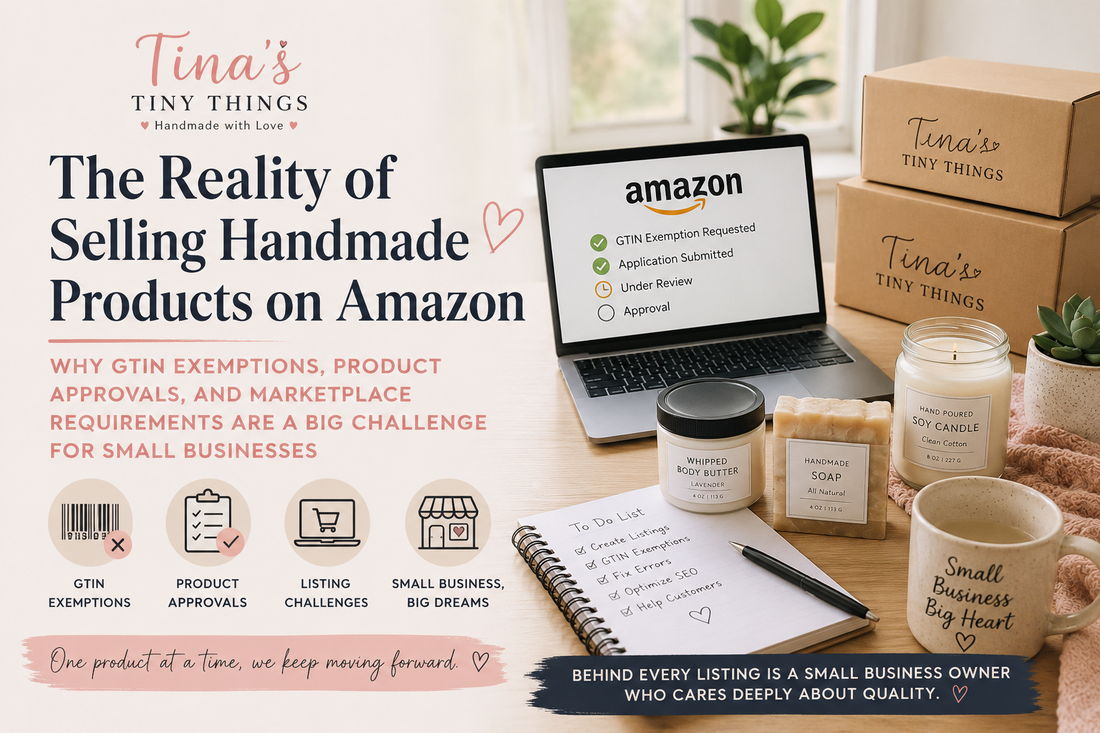
The Reality of Growing a Handmade Business: Why Getting Products on Amazon Isn't as Easy as You Think
At Tina's Tiny Things, we're constantly exploring new ways to get our products in front of customers who will love them. Whether it's through our website, local markets, social media, Shopify, or larger marketplaces like Amazon, we're always looking for opportunities to grow and share what we create.
What many people don't realize is that selling handmade products on major platforms can be a challenge, especially when you make most of your products yourself.
We've all seen Amazon's advertisements highlighting that more than 60% of sellers on their platform are small businesses. That's actually true, and if you browse through Amazon long enough, you'll notice many products are sold by independent merchants and small brands. We love seeing Amazon support small businesses and entrepreneurs.
However, there is a side of the process that most customers never see.
Because many of our products are handmade, they don't come with traditional UPC or GTIN barcodes like mass-produced products found in big-box stores. This means that before we can even list many of our products, we have to apply for what's called a GTIN exemption.
To be clear, we understand why Amazon requires this process. It helps protect customers, prevents counterfeit products, and ensures sellers aren't simply taking someone else's products and claiming them as their own. In many ways, it's Amazon's method of maintaining quality and trust on its marketplace.
The challenge comes when you're a legitimate handmade business.
At Tina's Tiny Things, we currently have around 150 different products. That means potentially 150 separate exemption requests, product listings, approvals, and submissions. And that's before considering product variations, sizes, scents, colors, and other options that many handmade businesses offer.
As a small business owner, that can feel overwhelming.
The interesting thing is that Amazon's product listing process is actually very impressive. When creating a listing, Amazon asks for detailed information about the product, descriptions, attributes, images, keywords, and other important details. The amount of information required helps optimize products for search and gives customers a better chance of finding exactly what they're looking for.
From an SEO perspective, it's actually a fantastic system.
Amazon is essentially helping sellers build listings that are optimized for search visibility and customer discovery. When done correctly, those listings have a much better chance of generating sales.
But here's where my frustration comes in.
Doing it once isn't bad.
Doing it 150 times is another story entirely.
Every submission can generate different errors, requests for additional information, or technical issues that need to be resolved. The process can take days or even weeks for a single product. Now imagine managing 150 products, 200 products, or even 1,000 products while also manufacturing, packaging, marketing, and shipping those products yourself.
That's the reality many handmade business owners face every day.
We also use Shopify, which offers apps designed to connect your store directly to Amazon. In theory, it's a wonderful solution. In practice, if your GTIN exemptions haven't already been approved, the products often generate error messages and fail to sync correctly.
Maybe part of this is simply a learning curve. Every platform takes time to learn, and Amazon is no exception. But from a small business perspective, it often feels like there should be a more streamlined process for verified handmade brands.
Our products are carefully crafted, thoroughly tested, and made with pride. We want customers to recognize the quality and care that goes into every item we create.
At the end of the day, perhaps Amazon's rigorous process serves a purpose. The amount of work required to successfully list products helps ensure that sellers are serious about what they're offering. It creates accountability and encourages quality standards.
Even though the process can be frustrating, it may also be one of the reasons customers trust the products they purchase there.
For now, we'll keep moving forward one product at a time.
Because that's what small business owners do.
We learn, adapt, overcome challenges, and continue finding new ways to bring our products to the customers who support us. The road may not always be easy, but every approved listing brings Tina's Tiny Things one step closer to reaching more families across the country.
And trust me, after listing product number 150, I'll definitely have earned a coffee break.


3 Comments
67 sigma ahh 67 67 I love eating soap ahhhhhhhhhhhhhhhhhhhhhhh
67 sigma ahh 67 67 I love eating soap ahhhhhhhhhhhhhhhhhhhhhhh
67 sigma ahh 67 67 I love eating soap ahhhhhhhhhhhhhhhhhhhhhhh